- URL: https://www.laruence.com/en/2026/09/16/6626.html
- Please include attribution when republishing.
Since GPT-6 Astra was released, its hottest use case has been modeling. It writes its own scripts in Blender, runs renders, inspects the results, tweaks a bit — and then an entire house is built.
Of course, some say it still can't handle irregular structures, that there are plenty of detail problems, that it looks good but isn't practical, and so on.
Those who follow me probably know that over the past few years I've been running Realsee, a startup working on reality-based 3D reconstruction. The VR home tours on Beike and the VR restaurant previews on Meituan are our work. So over the last few days I ran a series of tests: given real captured spatial data, how far can Astra's reconstruction ability go, and where are its limits?
Case study: a residence
I picked a new model apartment, captured with the Realsee Galois P4 — a tripod-mounted laser scanner we design and manufacture, notable for capturing panoramas up to 32K. It looks like this (if you've ever sold a house on Beike, you've probably seen it):

The data includes 16 kinds of assets (4.3GB): 24K HDR panoramas, high-precision point clouds, meshes, and more:
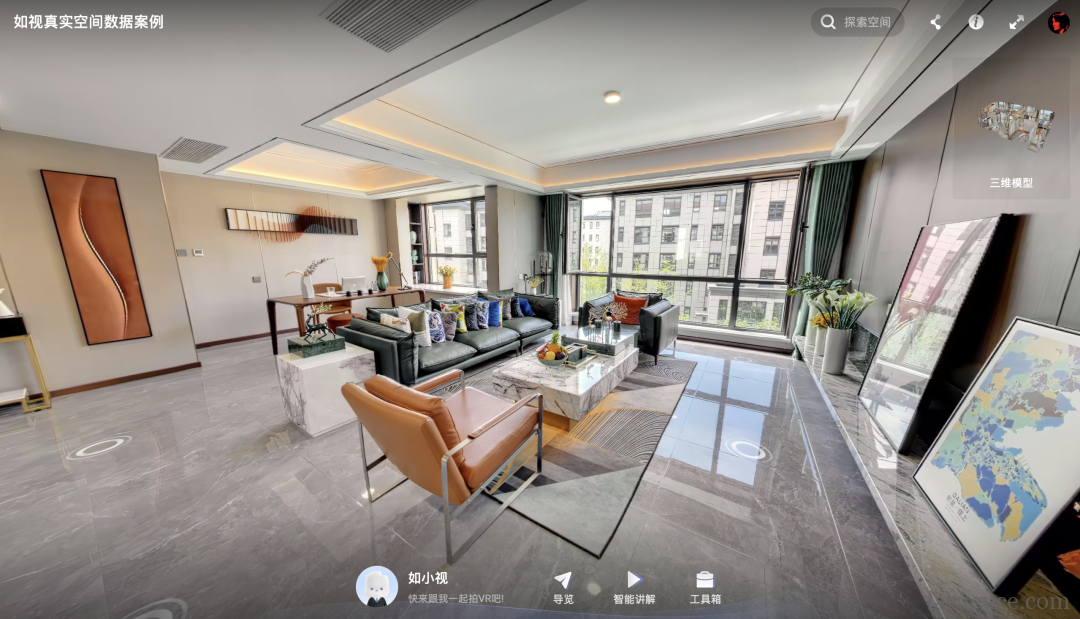
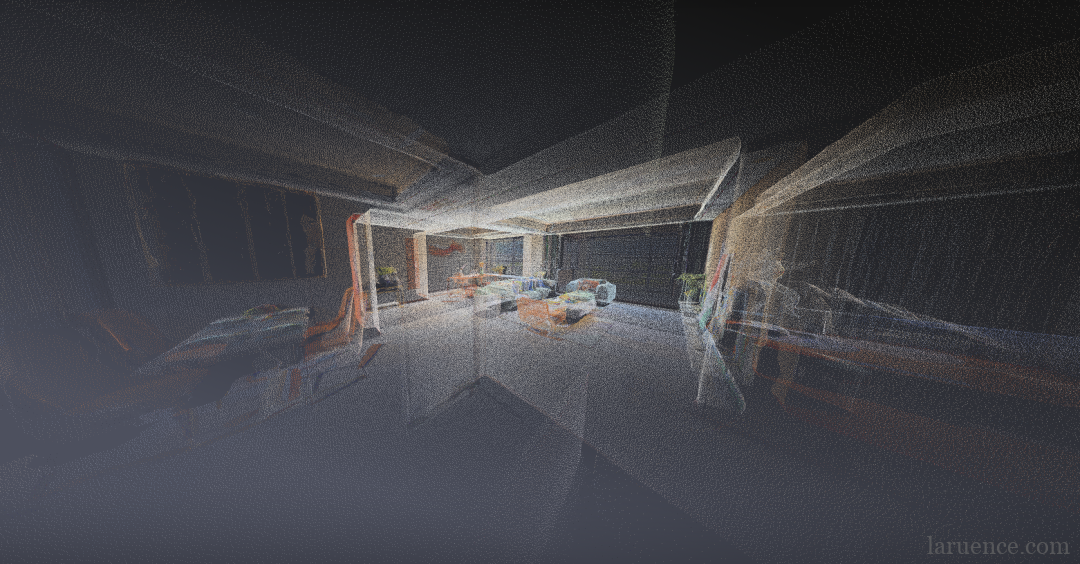
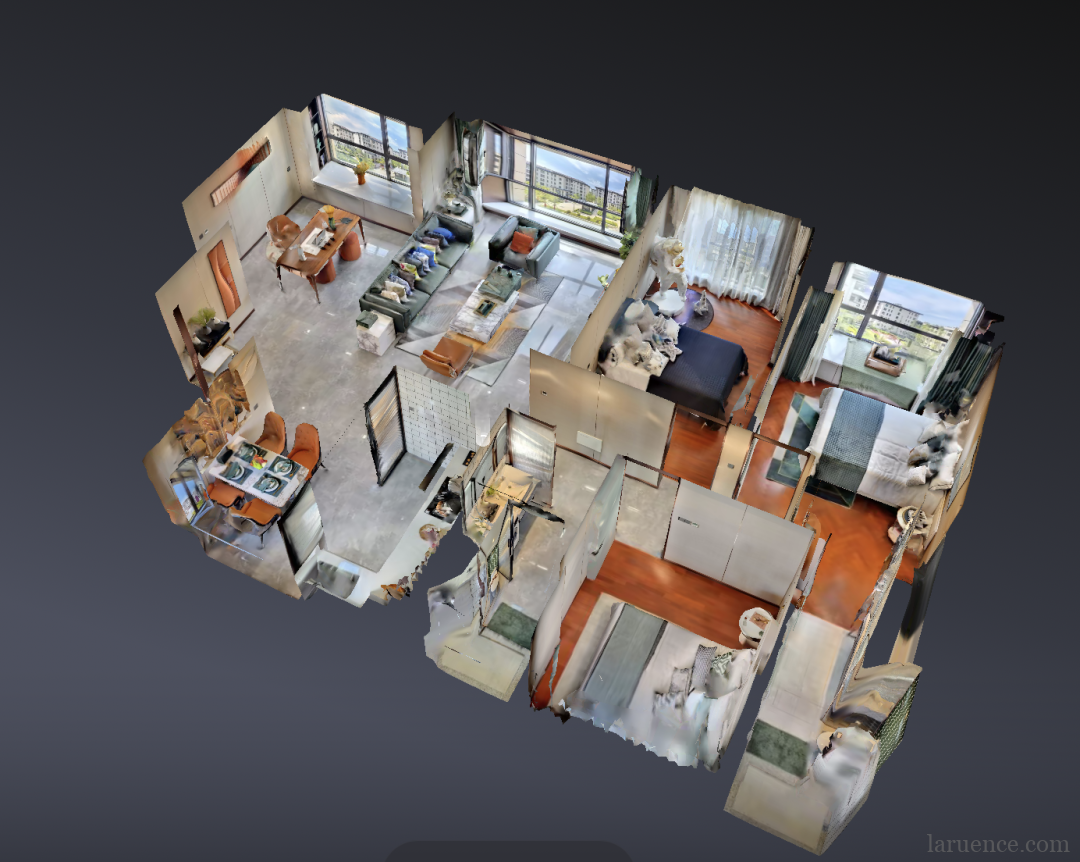
I handed GPT all 16 categories of data captured and produced by the Galois P4 (panoramas, HDR raws, depth maps, six-views, meshes, point clouds, poses, 3DGS, object recognition, floor plans, CAD, reflectivity, multispectral, etc.) and let it decide "what it needs". GPT's selection logic is dividing labor by purpose:
Floor plans establish room structure → point clouds and depth constrain geometry → recognition results help locate objects → panoramas and screenshots guide form and materials.
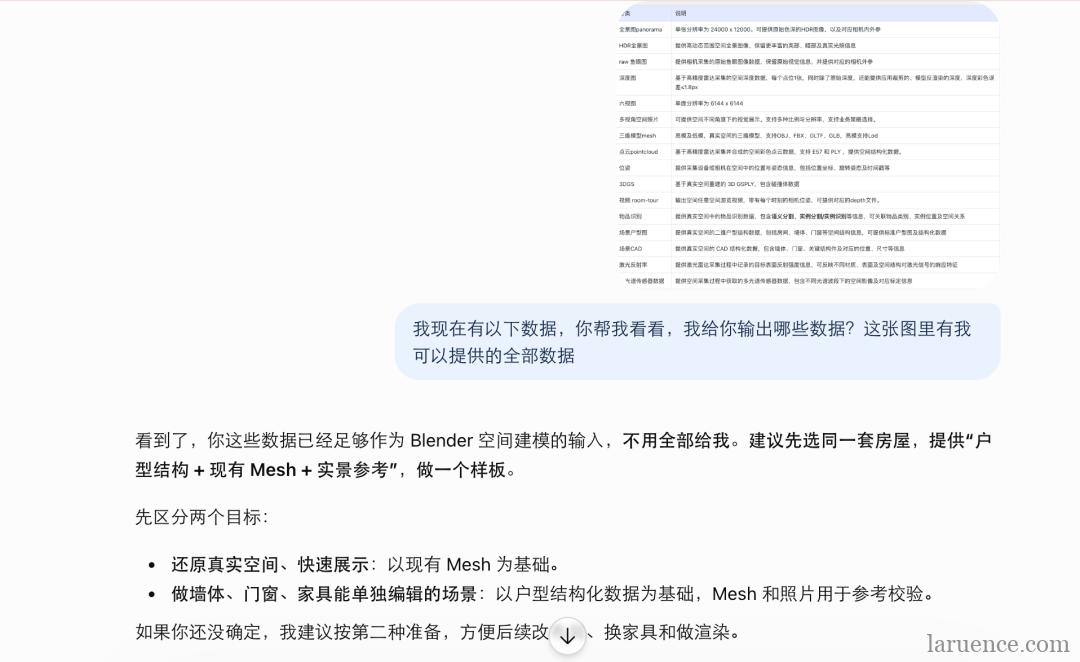
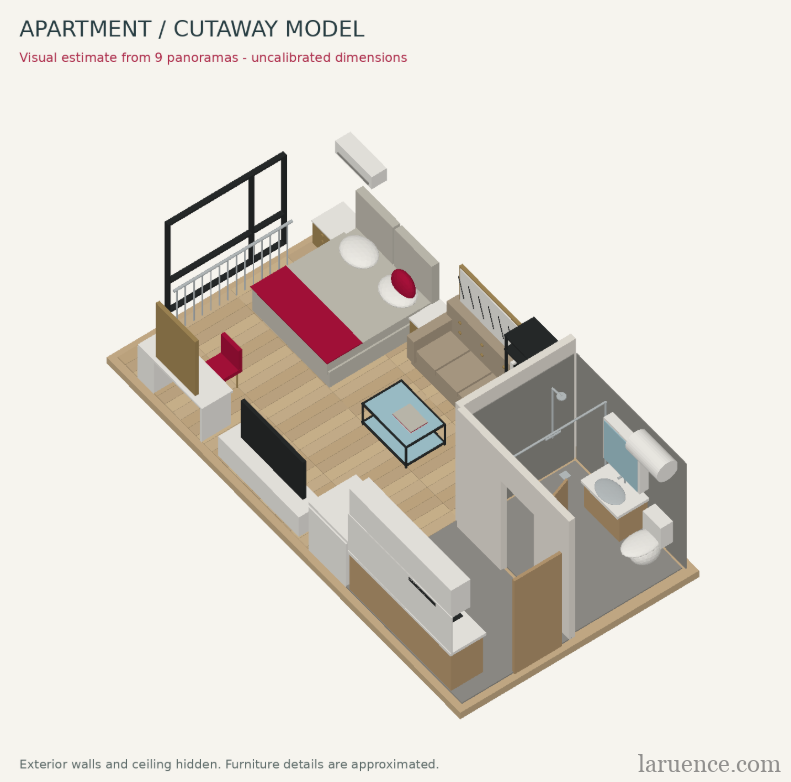
Round one, using "floor plan + mesh + floor-plan JSON + model archive":
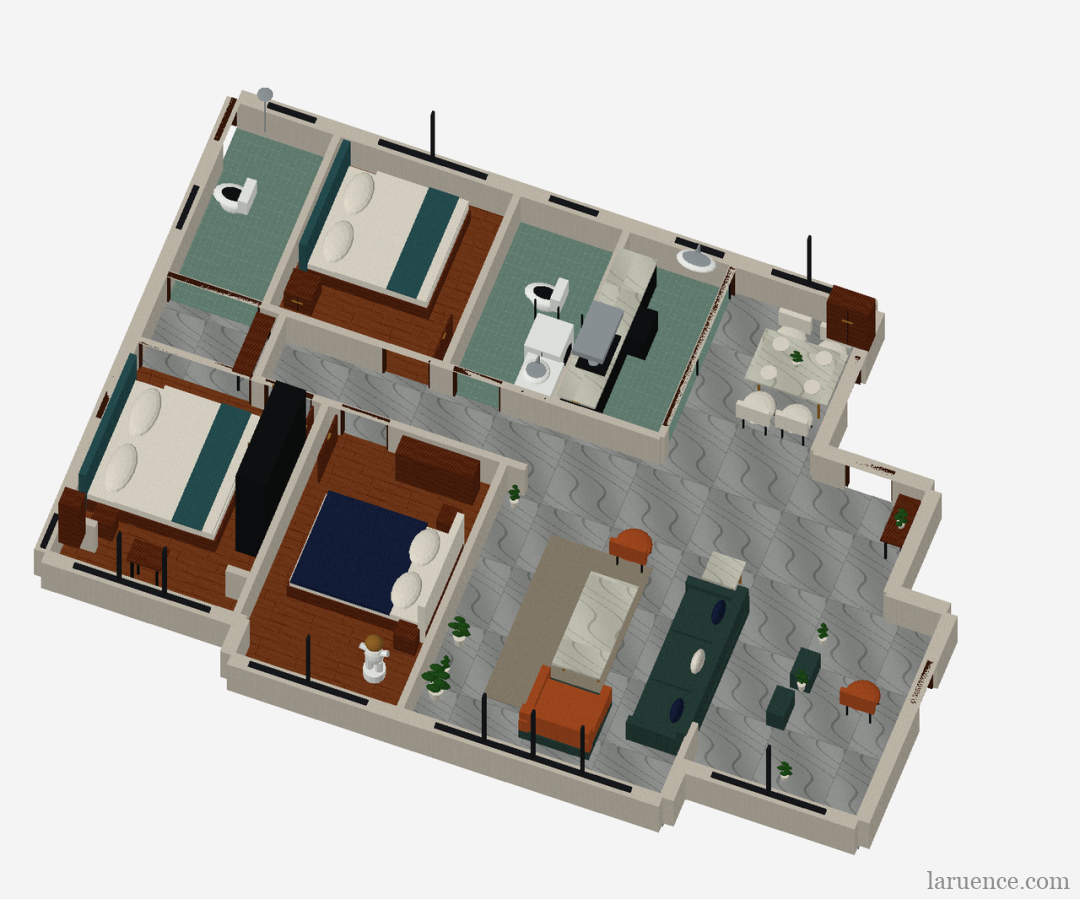
As you can see, it's still not great: the objects, the layout, the colors, the materials — none of them are quite right.
Round two: adding imagery, point cloud and depth data
I talked with GPT about the problems in its output: which aspects were reconstructed poorly, and what additional data it would need to improve the project.

GPT quickly understood what the point cloud, depth maps and high-resolution panoramas could each fix. With the new data, the output improved dramatically over round one:
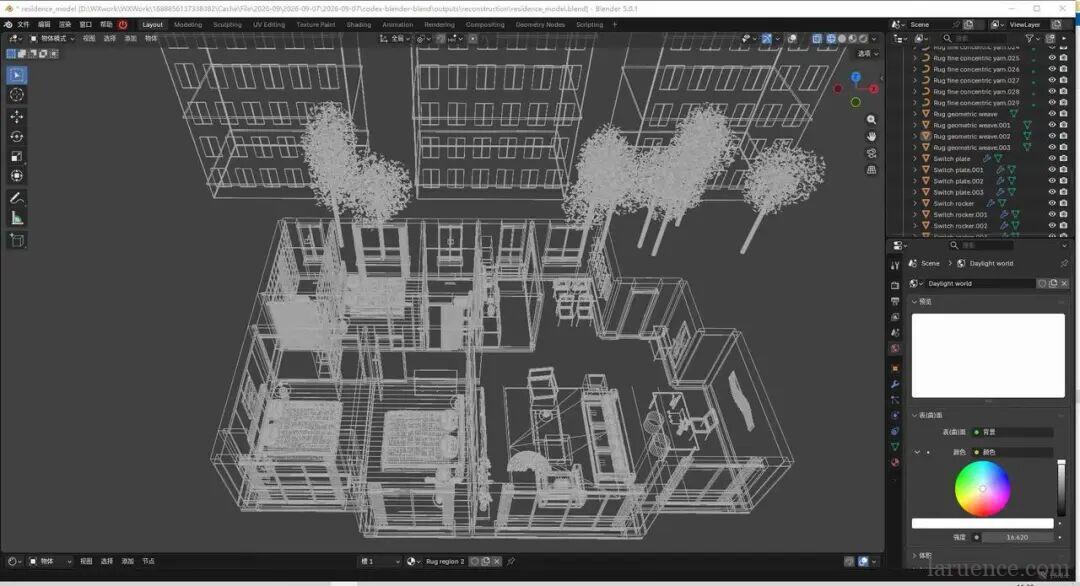
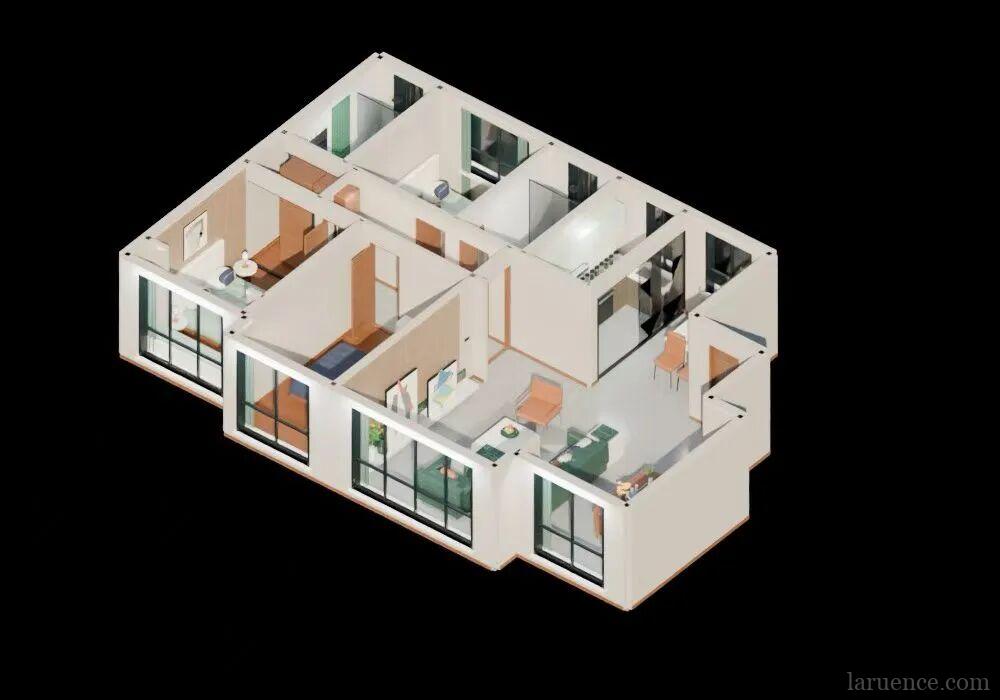
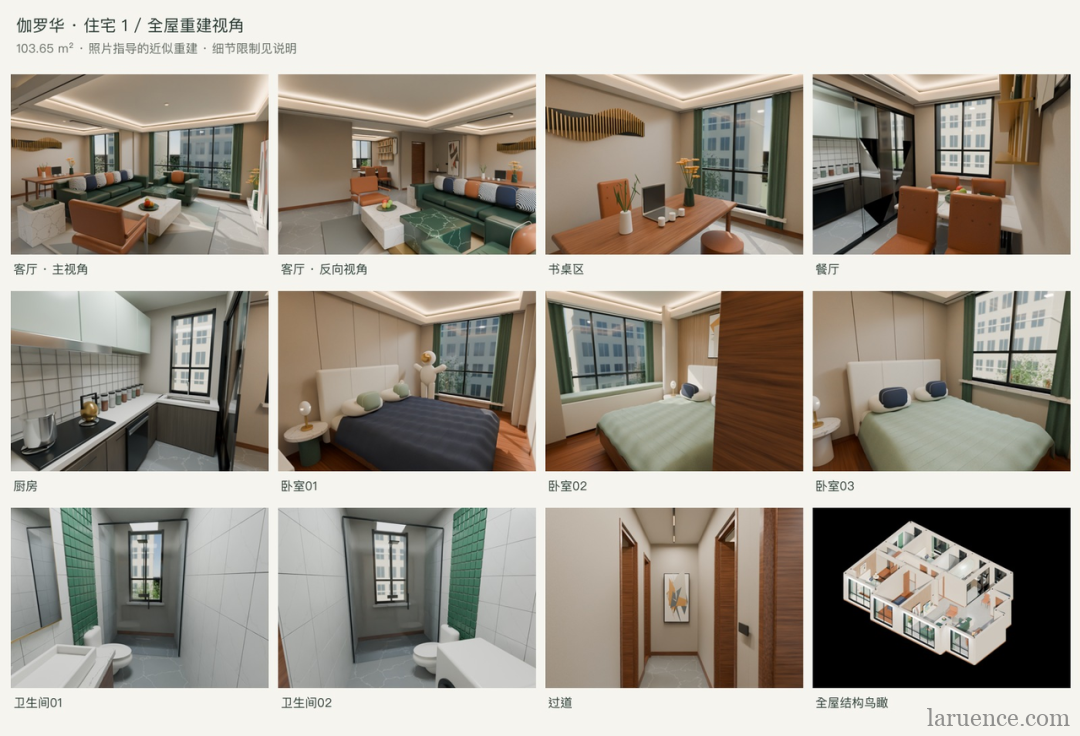
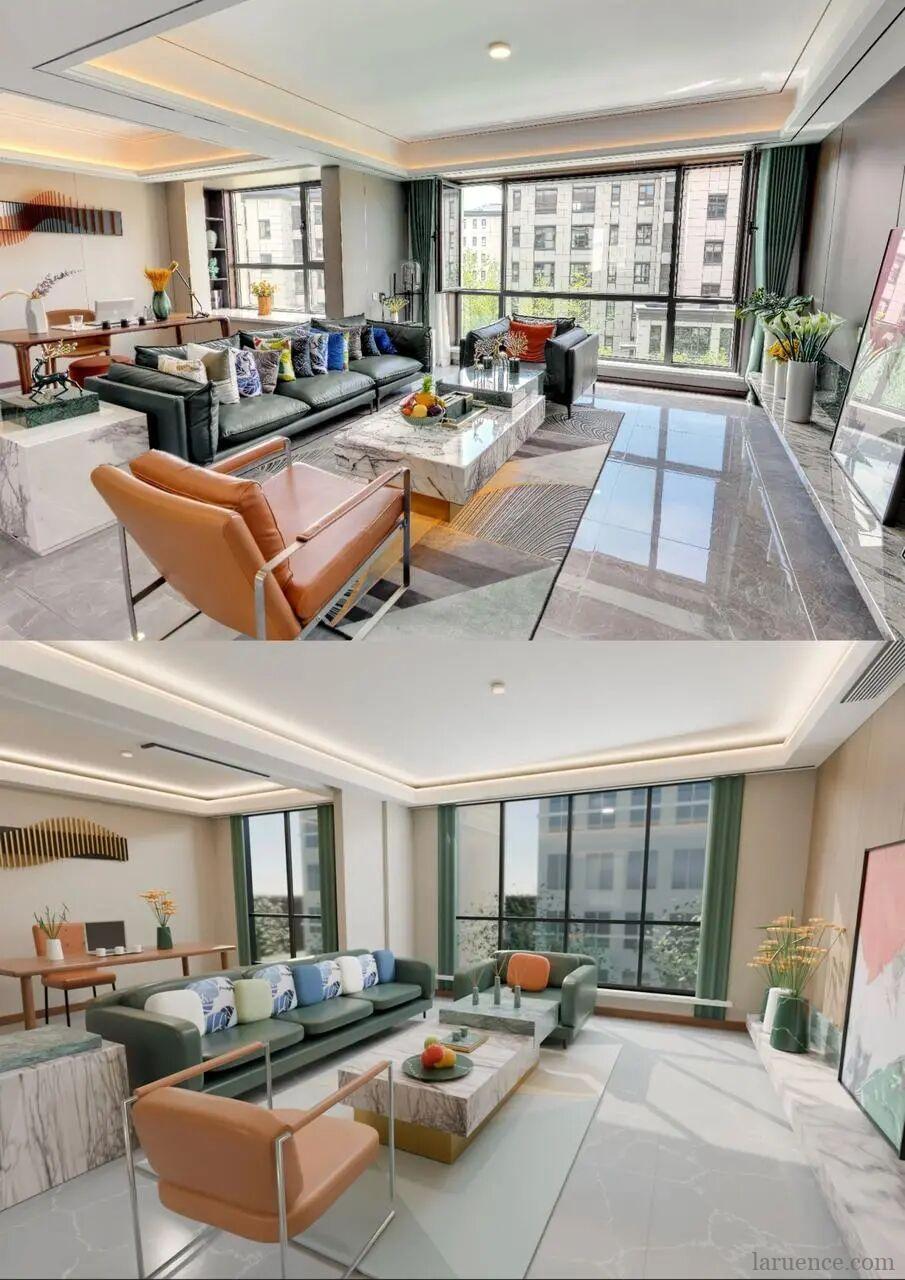
Above is the real 24K HDR panorama captured by the Galois; below is GPT-6's virtual render. By this point the overall layout, furniture types, colors, materials and orientations are essentially correct — even the view outside the window is similar.
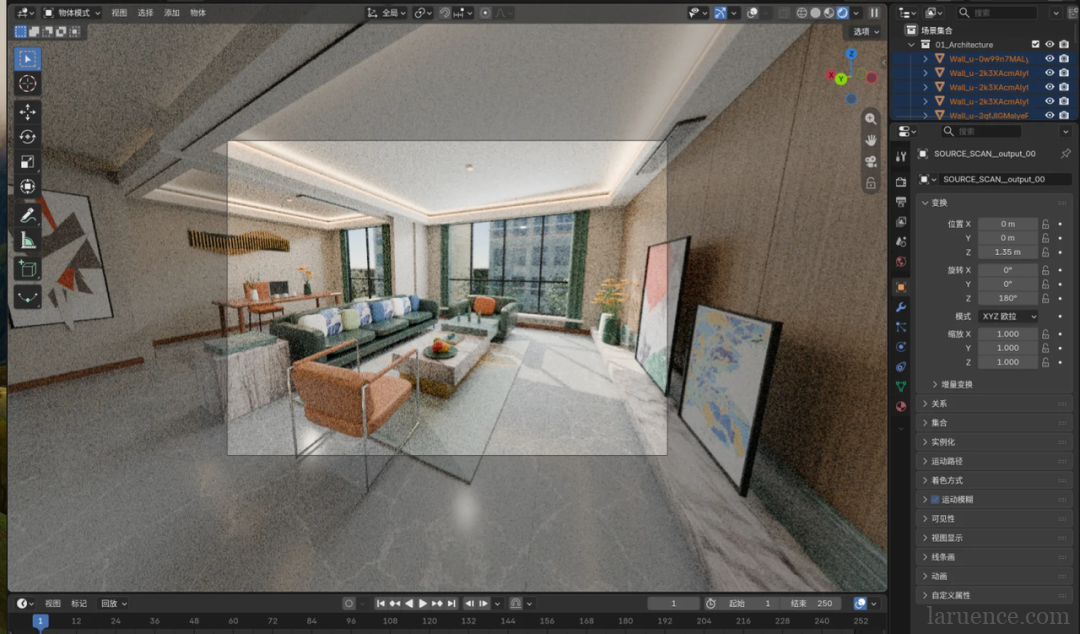
And every object has its own model and can be separated out. I feel like every piece of furniture went through this:
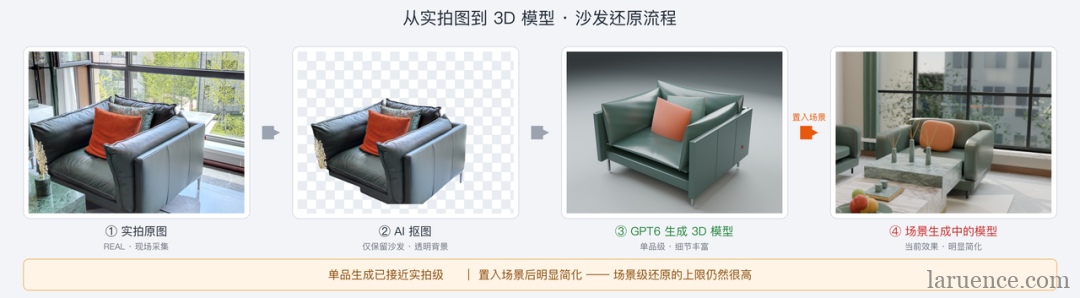
Overall, while there are still many small issues in the details, at first glance you can no longer tell virtual from reality. Truly stunning.
A control experiment: photos only
But if Astra is this strong, wouldn't tossing in a few photos work just as well?
I tried that too. Even with a prompt explicitly demanding high-fidelity reconstruction, with panorama-only input, GPT-6's result is still "guessed" from image understanding, based on assumptions about spatial structure. Individual objects are fine; but when large numbers of objects in the same space are bound by definite geometric relationships, reconstructing those relationships falls apart, and the overall structure and details look crude.
By contrast, feeding GPT-6 Astra more data — high-resolution imagery plus the corresponding spatial point cloud — means the spatial structure, measured dimensions, poses between images and layout relationships are all deterministic inputs, and the output quality rises accordingly.
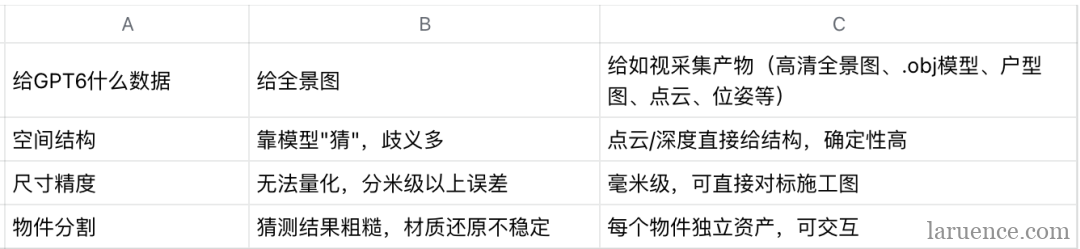
Same model: give it photos and it hands you imagination; give it high-quality data and it hands you engineering.
On the output side, this naturally brings:
- Higher certainty of spatial structure: laser scanning gives the true layout and connectivity of the physical space, not "image inference". Astra models with less ambiguity, takes fewer detours, and reduces structural ambiguity and manual correction costs.
- Millimeter-grade dimensions, ready for downstream use: hardware precision is passed directly to the model. Scenes exported in common formats like
.blend/.usdcarry real scale and can plug into more downstream applications. - Objects are segmentable, replaceable, exportable: every object is an independent asset — swap a material, animate it, export it, all fine. And because the source imagery is high enough quality, object textures come from real multi-view observations, not AI confabulation.
Where is this actually usable?
Wherever decisions need to be driven by spatial data, digital twins have value. Historically it was stuck on three things: modeling is expensive, cycles are long, precision isn't enough.
Now all three are loosening at once.
Trustworthy imagery, trustworthy dimensions, trustworthy structure, segmentable assets — only when all four are in place does downstream dare to build on it. Simulation, facility inspection, immersive tourism, safety training, including Sim-ready training for embodied AI, games and film production — all can run off the same dataset.
Finally
The most interesting part isn't that "AI can model now". There are still plenty of flaws, but I believe rapid AI iteration will overcome them.
It's this: when AI's execution is no longer the bottleneck, the bottleneck returns to the data itself.
Note what "data" means here: not "any data will do", but deterministic, metrically-scaled, multi-view, real-captured data. The stronger the model gets, the higher its demands on data quality — not lower — because it can exploit more dimensions of information.
Of course, it's also possible that I'm holding it wrong; corrections welcome in the comments.
Finally, here is a more detailed tutorial and a download link for the sample data:
 Read the original (Chinese) on my WeChat channel: 《GPT-6 Astra 做实景三维重建,我拿一套住宅试了试》
Be First to Comment